Friday, October 18, 2019

For Tuesday: Strayed, Wild, Part Two: Chs.4-7

Image result for wild strayed images


Be sure to read Part Two for Tuesday's class (I'm including Ch.4 here as well, even though I told you to read it for last time). We'll have another quiz when you get to class, so consider some of the following ideas:

* What is the significance of her last name? Where did it come from, and why does she say "I looked it up in the dictionary and knew it was mine" (96).

* Why does she worry that the lawyer will think they're getting divorced for the wrong reasons? Why does she want to get divorced? Or does she?

* She calls the hike the "hardest thing I'd ever done," even though she recently lost her mother and suffered a divorce. What makes this harder, and why does it make "the other hardest things the the tiniest bit less hard" (95)?

* What does she learn from the other hikers she encounters on the trail? What basic information has she neglected? Could some of this information have saved her life?

* What does she learn is the most unexpected hardship of the trail? What could no amount of training or reading have truly prepared her for?

* What prevents her from quitting the trail when she finally convinces herself to catch the first bus to Alaska?

* What does the experience with the bull teach her about the PCT and about life itself?

Friday, October 11, 2019

For Tuesday: Strayed, Wild, Chs. 1-4

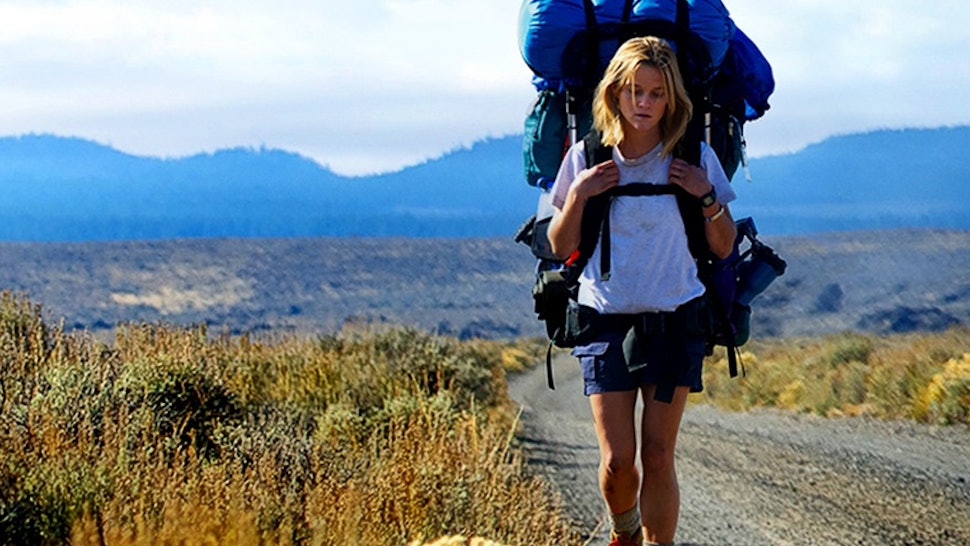
The author during her trek on the PCT
NOTE: Read as close to the end of Chapter 4 as you can by Tuesday. If you don't completely get there, no problem, but get close, since our quiz on Tuesday will expect you to have read at least 3/4 of this. Here are some questions to consider as you read, one of which will make an appearance on the quiz:

* How is Cheryl a bit like Christopher McCandless in Into the Wild? What problems and personality straits do both of them share? What might both be driven to explore the "wild"?

* Related to the above, what does the PCT represent for her? How is it like her "Alaska"?

* What are the "Ten thousand things"? What does this say about her relationship with her mother, and why she had so much trouble processing her death?

* Throughout these chapters, she throws herself into shallow affairs and eventually, drug addiction, almost as a way of punishing herself. Yet she says that "this is how "it must feel to people who cut themselves on purpose. Not pretty, but clean" (36). How is this kind of self-mutilation "clean"? 

* Why does she have vivid dreams--which she calls the "documentary films of her subconscious"--of killing her mother in various horrible ways? 

* Is she prepared for her journey on the PCT either physically or mentally? How is she a little like McCandless when he first sets out "into the wild" in Alaska?

Sunday, October 6, 2019

Conference Schedule for This Week

REMEMBER: no class this week, but you do have to come to your scheduled conferences. It's easy and painless; just come to my office for a 5-10 minute conference about your paper, so I can help you see what works and what you might need to work on for future assignments (or to revise this one). BRING YOUR INTO THE WILD QUESTIONS WITH YOU! Otherwise, you won't get credit for them. If you need to change your conference time, no problem--just let me know as soon as possible. 

If you missed class last Thursday, let me know which of the open times you can attend. If you just show up, I might not have your paper with me, so please tell me in advance.


TUESDAY
9:30 Holly
9:40 Eva
9:50 William
10:00 Chandler
10:10 Bryce
10:20 Sofia
10:30 Cece
10:40 Jorden
10:50 Bo

11:00 Megan
11:10 Brayden
11:20 Maddie C.
11:30 Jarod
11:40 Kensie
11:50 Hailey P.
12:00 Jagger
12:10 Gavin
12:20 Felicia
12:30 Shelby

WEDNESDAY
1:00 Payton
1:10 Preston
1:20 OPEN
1:30 Conner
1:40 OPEN
1:50 OPEN
2:00 OPEN
2:10 Chandler B.
2:20-3:00: OPEN 

THURSDAY
9:30 Trenton
9:40 Zully
9:50-10:10 OPEN
10:20 Cora
10:30 Haley L.
10:40 Megan
10:50 Matthew

11:00 Alexis
11:10 Addison
11:20 Garren
11:30 Brandon
11:40 Rylan
11:50 Jadon
12:00 Willow
12:10 Maddie L.
12:20 Kaleigh
12:30 Alayna

1:00 Emily
1:10-3:00 OPEN 

Tuesday, October 1, 2019

For Thursday: Into the Wild (see below)


This week, we're watching the film Into the Wild (2007) as an introduction to our next book, Cheryl Strayed's book, Wild (not on the same subject--but a similar theme). I'll hand out questions on Thursday's class to be turned in during our conferences next week.

We'll sign up for individual conferences on Thursday as well, so try not to miss. You must attend an individual conference to be 'present' for class next week; otherwise, you'll get two absences and you'll have to wait even longer to get your paper back. 

REMEMBER that papers are due by 5pm today (Tuesday)! You can turn it in late, but you lose ten points a day for a maximum of two days. After that, you get a zero. So be careful! 

Thursday, September 19, 2019

For Tuesday: Heller, "The Digital Republic" (pp.143-162)


Be sure to read "The Digital Republic" for Tuesday's class. We'll have a quiz, but it will be a slightly different quiz--no short answer questions, but just one longer essay question (since too many people are spending all their time looking up the short answers, and then offering a quick, vague response to the essay question--which is the most important part!). 

Some ideas you might consider:

* How might this article offer a naysayer response to the idea in our last essay of "the internet of things"? Do they want everything to be connected? Is that a utopia for most Estonians? 

* As one Estonian says in the article, "in today's world, everything will be public at some point" (161). Why should all information be increasingly public--and how will this help protect countries like Estonia in the long run?

* Why do many Estonians feel that "it is possible to imagine a future in which nationality is determined not so much by where you live as by what you log on to" (158)? Why is that an important goal? How is it somewhat utopian in their eyes?

* How does this essay address the naysayers, particularly those who might say, "if you're a citizen of the world, you're a citizen of nowhere"?

* Why is Estonia (a nation most people have never even heard of) so far in advance of this kind of technology and thinking? What makes them uniquely qualified (or inspired) to develop it?

* Why is internet citizenship in Estonia relatively popular around the world? What is the advantage that some people see in this unorthodox approach to business? 

* Why does this essay argue that to change the world, you have to change how you think about society? 

Conversation Paper #1 due Tuesday, October 1st by 5pm


Conversation Paper #1: Traveling to Utopia

One of the advantages of reading about other cultures is the sense of being an outsider looking into a completely strange and mysterious world: in some ways, it’s like peering into the future. This is especially true when the societies are trying to transform cutting-edge ideas into new ways of thinking and being. In the essays we read for class, Japan, Korea, and Estonia are all chasing perfection in their own way. The question is, should we follow their example? Are they leading us to a brave new world…or an apocalyptic nightmare?

Choose one of the topics below and discuss why, to you, it comes closest to creating a modern-day utopia. OR, write a paper where you discuss why one of the following is recipe for a dystopia in the making:

  • A world where everything is viewed as art, and expensive quality is better than affordable quantity: “Biting into one sliver of the fruit, I had the sense I was tasting in color for the first time” (37).
  • A world where technology can erase our human weaknesses and make us better versions of ourselves: “The automation of society seems to feed directly into the longing for perfection; a machine will simply do things better and more efficiently, whether scanning your license plate or annihilating you at a Go tournament” (262).
  • A world where everyone is part of a global community, without borders, states, or nations: “nationality is determined not so much by where you live as what you log onto” (158).
The GOAL of this assignment is to have a conversation about what could solve our  society’s problems—or potentially make them worse. Choose only ONE of the topics above and explore it through other writers’ ideas and concerns, responding to them with your own insights or observations we made in class. Make sure to include a NAYSAYER response from other sources (see below).

SOURCES: You must have at least FOUR sources for this paper: TWO must be essays from class (feel free to use one of the quotes I provided), and TWO must be outside articles, books, or websites. We’ll discuss how to do this in class next week. Be sure to QUOTE your sources and integrate them into your paper (don’t simply sprinkle unrelated quotes throughout your paper). Use the sources to help you see more sides of the story, and consider ideas that you may not have considered before. In other words, try to respond to other voices—don’t try to write the entire essay by yourself!

REQUIREMENTS:
  • At least 4 pages, double spaced, but you can do more
  • At least 4 sources, 2 from our essays, 2 from journals, web, etc.
  • Quote sources and integrate them into your essay
  • Show a conversation between your ideas and other essays/writers
  • DUE Tuesday, October 1st by 5pm

Friday, September 13, 2019

For Tuesday: Shteyngart, "Thinking Outside the Bots" (pp.259-271)


Consider some of the following for Tuesday's reading and quiz:

* Why did a game of Go cause South Korea to get so interested in AI technology? For them, what did the results of the famous match tell them?

* In South Korea, technology has come to embrace the "internet of things". What is this, and how does it change the reality of South Korean life?

* Why does AI technology offer the promise of perfection--or as someone says in a commercial, "Why should I live like this, being less than perfect?" Do you think this perfection is achievable--or just an illusion?

* According to the author, why do countries like South Korea take so readily to technological innovation? Why don't they mind "Big Brother" in the same way Americans might?

* What are the dangers of perfecting AI technology? Why might a too-intelligent robot be just as dangerous as a completely 'stupid' one?

* One of the scientists in the article predicts in the future, "Everything will be roboticized." Do you feel this author is excited about this prospect? Are we?

* What does he mean by the quote, "The future is already here. It's just not very evenly distributed"? Why is this especially true in South Korea? 

* Why is the image at the end of the essay significant: the woman recording her prayers at the Zen Rock with an I-phone?